
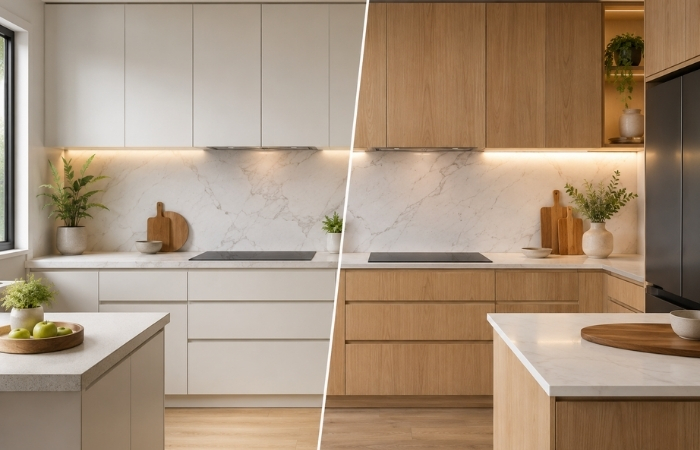
Choosing between laminate and veneer cabinets comes down to one question. Do you want consistency and low maintenance, or natural character and warmth? Both finishes can look fantastic in a Melbourne kitchen, but they perform very differently once daily life takes over.
Laminate is a synthetic surface bonded to a board core. Veneer is a thin layer of real timber applied over that same core. The difference in material shows up in price, durability, appearance and how each finish ages over ten or twenty years.
Most homeowners land on this decision partway through a kitchen renovation, once benchtops and layout are locked in and the door and panel finish becomes the last major choice left to make. Getting it right here shapes how the whole room feels for years, not just how it photographs on day one.
What Are Laminate Cabinets
Laminate cabinets use a manufactured surface, usually a printed decorative layer sealed under a hard-wearing resin coating, pressed onto a substrate like MDF or particleboard. Modern laminates replicate timber grain, stone, matte colours and even textured finishes convincingly.
The appeal is consistency. Every door and panel comes out looking identical, with no colour variation or grain irregularities to account for. Laminate also resists moisture, scratching and fading better than most natural finishes, which matters in a kitchen that sees heat, steam and daily wear.
What Are Veneer Cabinets
Veneer cabinets use a thin sheet of real timber, typically 0.5mm to 3mm thick, glued to a board substrate. You get genuine wood grain, colour depth and texture that no printed surface fully replicates.
Because veneer is a natural material, no two sheets are identical. Grain patterns shift across panels, and colour can vary slightly between boards cut from different sections of the same tree. For homeowners who want a kitchen with organic character rather than uniform perfection, this is a feature rather than a flaw.
Why the Difference Matters
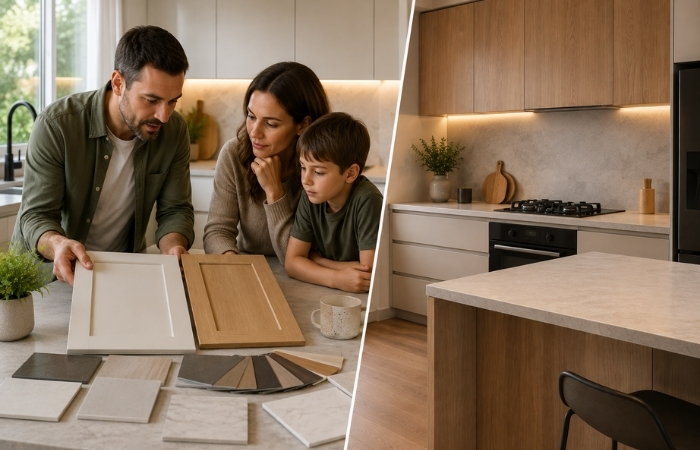
The finish you choose affects more than looks. It shapes your maintenance routine, your budget, and how the kitchen holds up against Melbourne's mix of humid summers and heating-heavy winters.
Think of it less as a material decision and more as a lifestyle match. A young family running a busy kitchen every day has different priorities to a couple finishing a forever home around a premium look. The comparison below sets out exactly where each option pulls ahead, so you can weigh it against how your household actually uses the space.
How Laminate and Veneer Perform Over Time
Here's how the two finishes compare across the factors that matter most in a working kitchen.
| Factor | Laminate | Veneer |
|---|---|---|
| Appearance | Uniform, consistent colour and pattern | Natural grain, slight variation between panels |
| Durability | High resistance to scratches and moisture | Good, but more sensitive to prolonged moisture and sun exposure |
| Maintenance | Wipe clean, minimal upkeep | Occasional oiling or resealing may be needed |
| Cost | Generally lower | Higher, closer to solid timber pricing |
| Repair | Difficult to spot-repair, often needs full panel replacement | Can sometimes be sanded and refinished |
| Best for | Busy households, rentals, high-traffic kitchens | Feature kitchens, resale value, timber-look interiors |
Style Trends Worth Knowing
Kitchen trends shift the appeal of each finish over time, and it's worth knowing where things stand right now before you commit.
Matte laminate finishes in deep charcoals, olive greens, and warm neutrals have overtaken high-gloss white as the most requested laminate option in Melbourne kitchens. They hide fingerprints better, read as more contemporary, and pair well with stone benchtops.
Veneer has seen a shift toward lighter, natural timber tones such as European oak and blackbutt, replacing the darker walnut and jarrah finishes that dominated a decade ago. Lighter veneers open up smaller kitchens visually and suit the broader move toward Scandinavian-influenced interiors.
Neither trend makes one material objectively better. But if resale timing or a specific aesthetic matters to your renovation, it's worth checking which direction your street or suburb is leaning before locking in a finish.
Longevity and Sustainability Considerations
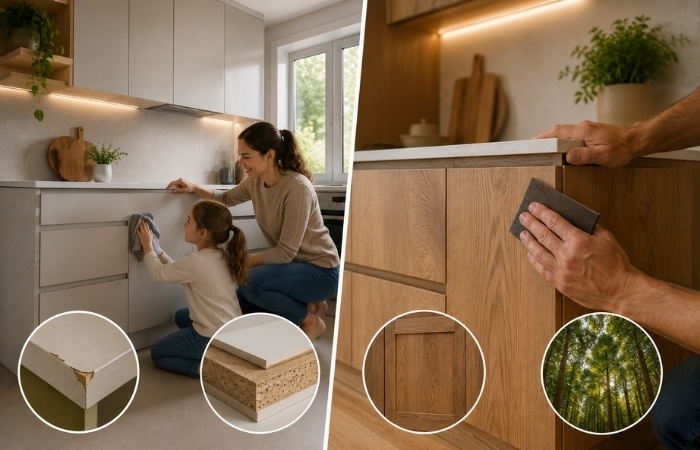
Lifespan is where the two materials diverge in ways that aren't always obvious at the quote stage.
Quality laminate, properly installed, typically lasts 15 to 20 years before edges or high-wear zones need attention. It's a manufactured product, so its environmental footprint depends heavily on the substrate and adhesives used underneath the surface layer.
Veneer, being a thin layer of real timber, can often be refreshed rather than replaced. A light sand and reseal can extend its life well beyond 20 years in many cases, which appeals to homeowners who'd rather restore a surface than replace it. It also uses less raw timber than solid wood cabinetry while still delivering a genuine timber look, which matters to buyers weighing sustainability alongside style.
Step-by-Step Guide to Choosing Between Them
Working through these steps will narrow the decision quickly.
Set your budget range first. Laminate typically costs less per square metre than veneer, so this alone can settle the decision for cost-sensitive renovations.
Think about daily use. Families with young kids, high foot traffic, or a kitchen doubling as a workspace usually get more out of laminate's durability.
Consider your design direction. If you're chasing a warm, natural, high-end look, veneer delivers a depth that laminate can't fully match.
Factor in maintenance tolerance. Veneer needs a bit more care around spills, heat, and direct sun. Laminate is closer to set-and-forget.
Check long-term plans. If resale value or a premium finish matters for your property, veneer often adds more perceived value.
Get the finish in hand before deciding. Photos rarely capture how a laminate or veneer sample feels and reflects light in your actual kitchen space.
Ask about warranty coverage. Laminate and veneer products often carry different warranty terms for delamination, cracking, or discolouration. Understanding what's covered, and for how long, protects you from unexpected repair costs down the track.
Common Mistakes to Avoid
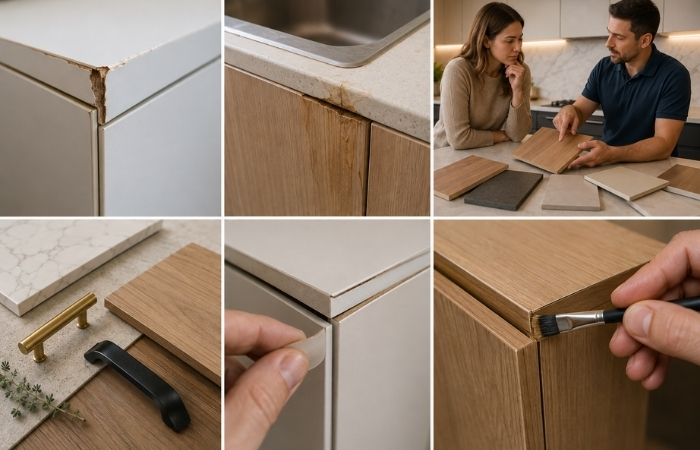
A few issues come up repeatedly when homeowners choose between these finishes without proper guidance.
Choosing laminate purely on price without checking the quality grade is a common misstep. Lower-grade laminates can peel or delaminate at edges within a few years, while higher-grade options hold up for decades. Similarly, choosing veneer without asking about the sealant and finish coat can lead to premature water damage in splashback zones near sinks and cooktops.
Another frequent error is ignoring how the finish will age against existing benchtops, flooring, and hardware. A finish that looks perfect in isolation can clash once installed alongside the rest of the kitchen.
Homeowners also sometimes skip asking about edge detailing. Laminate edges are usually finished with matching PVC or ABS edge banding, and cheaper banding tends to lift first, particularly around sinks and dishwashers where moisture collects. Veneer edges need careful sealing at joins to stop moisture creeping in behind the timber layer. Asking your cabinet maker how edges are finished, not just what the face material is, often reveals more about long-term durability than the surface choice alone.
Frequently Asked Questions
Is veneer more expensive than laminate?
Yes, generally. Veneer costs more due to the natural material and the additional labour required to match grain and colour across cabinetry runs. Laminate is more budget-friendly for most kitchen renovations.
Which finish is more durable, laminate or veneer?
Laminate typically holds up better against scratches, moisture, and daily wear because of its resin-sealed surface. Veneer can last just as long with proper care, but it's more sensitive to prolonged sun exposure and water contact.
Can veneer cabinets be repaired if damaged?
In many cases, yes. Because veneer is real timber, it can sometimes be sanded back and refinished to remove minor scratches or marks. Laminate generally can't be repaired the same way and often needs full panel replacement.
Does laminate look cheap compared to veneer?
Not with modern laminates. High-quality laminate finishes now replicate timber grain and texture convincingly, and many homeowners choose laminate specifically for its consistent, contemporary appearance rather than as a budget compromise.
Which option adds more value to a home?
Veneer often carries a slight edge for resale value due to its natural material and premium feel, particularly in higher-end properties. That said, well-installed, quality laminate cabinetry still holds strong appeal for buyers prioritising practicality.
Choosing With Confidence
Laminate and veneer both have a place in a well-designed kitchen. The right choice depends on how you use the space, what you're willing to maintain, and the look you want to live with for the next decade or more.
If you're still weighing it up, go back to how your household actually operates day to day rather than how the kitchen looks in a showroom. A busy family kitchen that sees constant traffic, spills, and quick clean-ups will get more long-term value from laminate's durability and low maintenance. A kitchen built around entertaining, resale value, or a specific design vision often justifies veneer's higher upfront cost for the natural warmth it brings to the room.
It's also worth remembering that this decision doesn't have to be all or nothing. Plenty of Melbourne kitchens mix both finishes, using veneer on feature elements like an island or open shelving while relying on laminate for high-wear zones such as base cabinets and pantry doors. That approach can deliver the aesthetic lift of timber where it's seen most, without exposing it to the areas that take the most daily punishment.
Whichever direction you lean, the finish should be chosen alongside people who work with both materials every day and can flag how each will perform in your specific layout, lighting, and lifestyle.
Contact us to get a free quote and talk through which finish suits your kitchen, your budget, and how you actually use the space day to day.


Magri Cabinets Assistant
Online • Craftsman Expert